
Introduction to Astrophysics and Space Flight
This course provides an introduction to two closely related fields of space science: Astrophysics and Astronautics (Space Flight). The course is divided into two independent modules, each culminating in a separate oral examination.
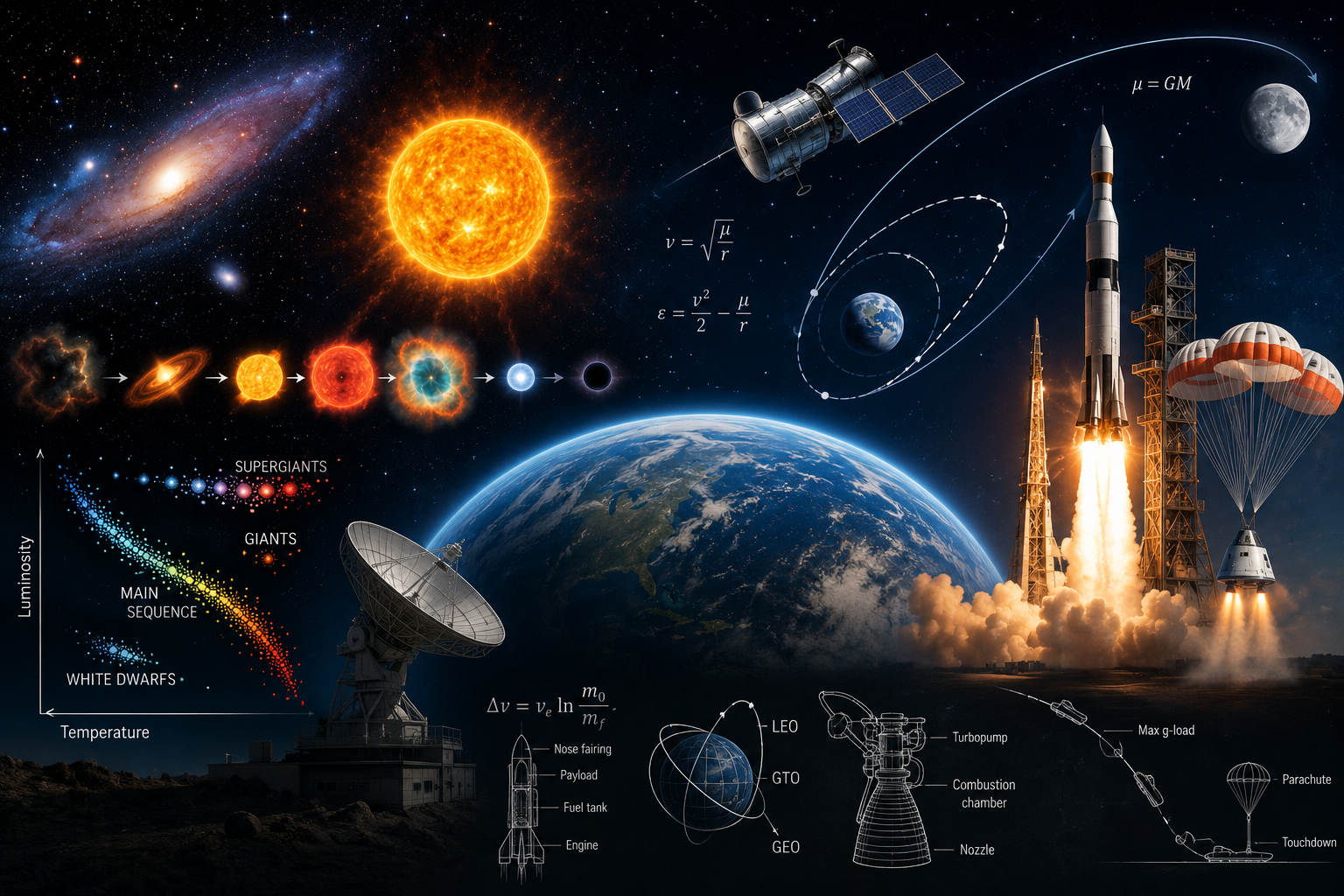
The Astrophysics module introduces the physical processes governing stars, galaxies, and the Universe. Students study stellar structure and evolution, energy generation and transport in stars, stellar spectra and classification, compact objects such as white dwarfs, neutron stars, and black holes, the Sun and the Solar System, as well as the large-scale structure of the Universe. Fundamental astronomical methods, including photometry, stellar magnitudes, and distance measurements, are also covered.
The Astronautics (Space Flight) module covers the principles of space missions and spacecraft engineering. Topics include the history of space exploration, orbital mechanics, orbital maneuvers, lunar and interplanetary missions, rocket propulsion systems, spacecraft subsystems, guidance and navigation, launch operations, and atmospheric entry, descent, and landing techniques.
The course combines theoretical lectures with the solution of practical example problems. By the end of the course, students will understand the fundamental physical principles governing celestial objects and spaceflight, and will be able to apply basic quantitative methods to astrophysical and astronautical problems.
- Õpetaja/Teacher: Vladislav-Veniamin Pustõnski